
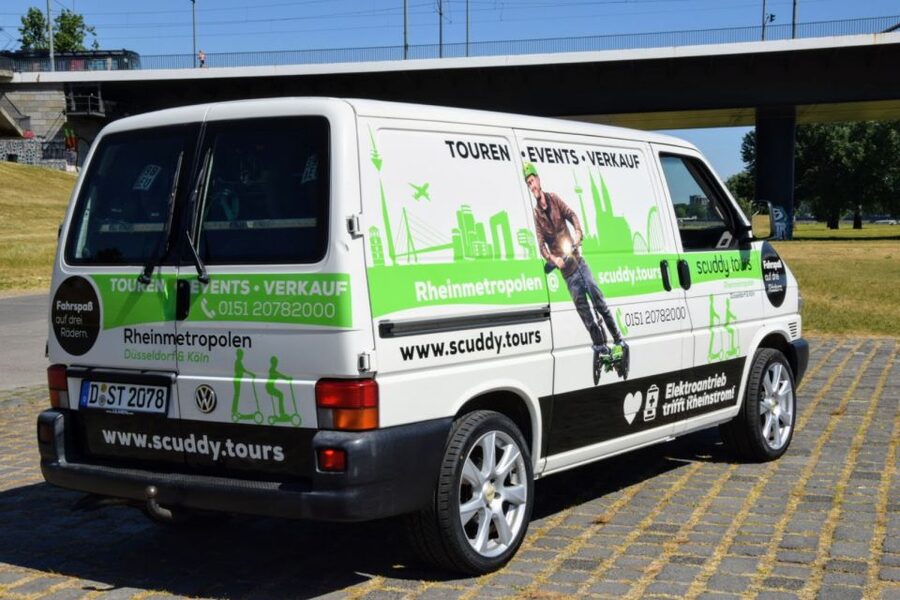
Review · GERMANY SCOOTER TOURS
Düsseldorf: E-Scooter City Tour
Düsseldorf’s Scuddy tour gives you a quick, playful look at the city from the Rhine Tower to the old town and back. You can ride sitting or standing, which makes the vehicle less tiring than a bicycle and adds a little amusement to a standard city tour. I like the small group, capped at seven, and the mix of river views, old streets, art, fashion, and bold modern buildings. The main catch is that the tour is German only, and the city commentary may feel light if you want a serious art or history lesson.
I especially like the route’s variety: the leaning tower of St. Lambertus, Andreas Quartier, K20, Hofgarten, Kö-Bogen II, and the striking Drei-Scheiben-Haus all appear within two hours. I also like the relaxed tone associated with guide Dieter, who adds jokes and local color. One consideration is that the information can be uneven, so this works best as a fun way to get oriented rather than as Düsseldorf’s definitive history tour.
Key points at a glance
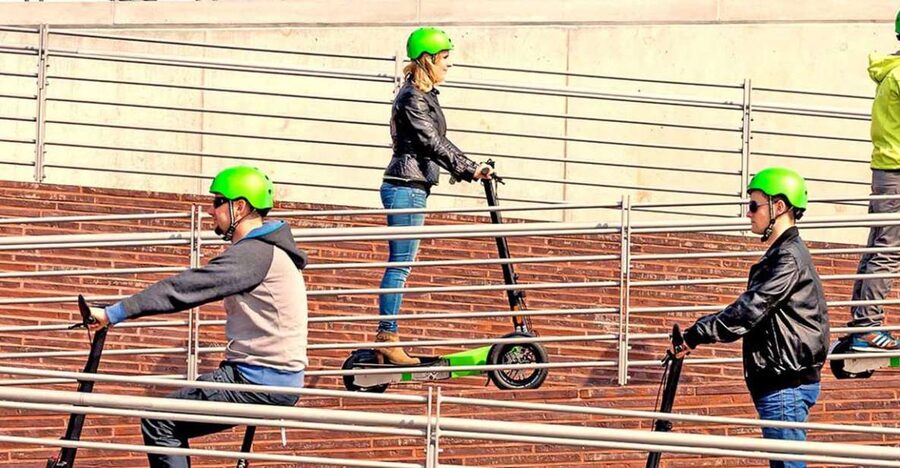
- A Scuddy is easier to enjoy than a bicycle: Ride in a sitting or standing position while moving through the city.
- The route links old and new Düsseldorf: You see Burgplatz, St. Lambertus, the Rhine promenade, K20, Kö-Bogen II, and 1960s architecture.
- Small groups keep the ride personal: Tours run with 2 to 7 people.
- Guide Dieter adds humor and local character: His tours include regular stops and casual stories about buildings and the city.
- The Rhine Tower is the starting landmark: Meet near the entrance barrier in the parking lot in front of the Rheinturm.
- German is the only tour language: You need a valid driver’s license to take part.
Starting beneath the Rhine Tower
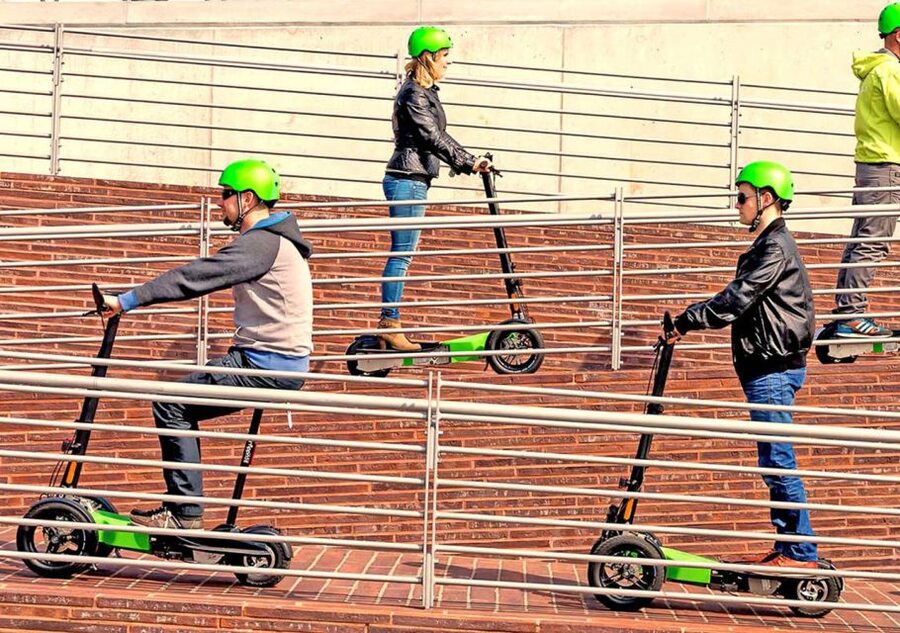
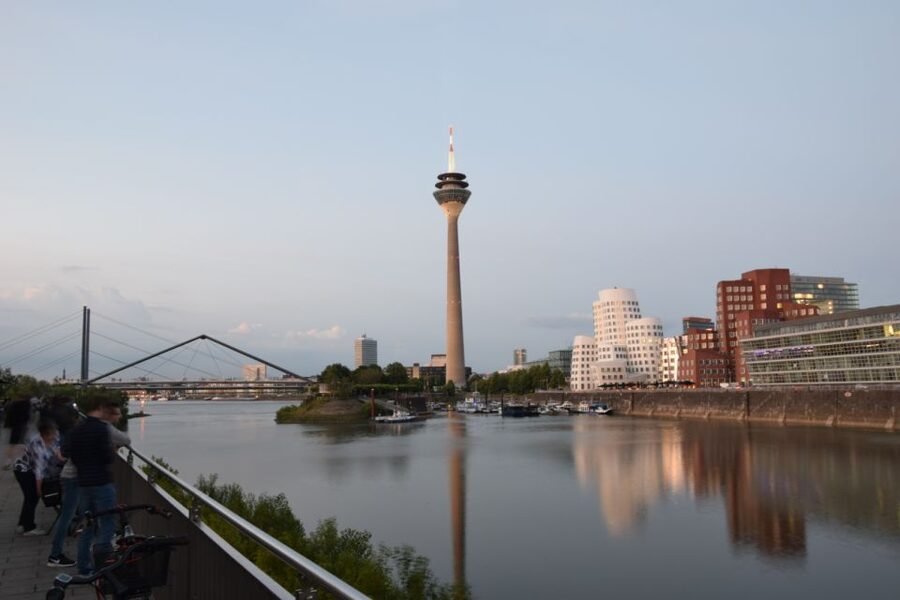
The tour begins at the Rheinturm, Düsseldorf’s tallest building. Your guide waits in the parking lot near the entrance barrier, directly in front of the tower. This is a useful meeting point because the Rhine Tower is easy to identify, though you should allow a little time to find the exact parking area rather than simply walking to the tower entrance.
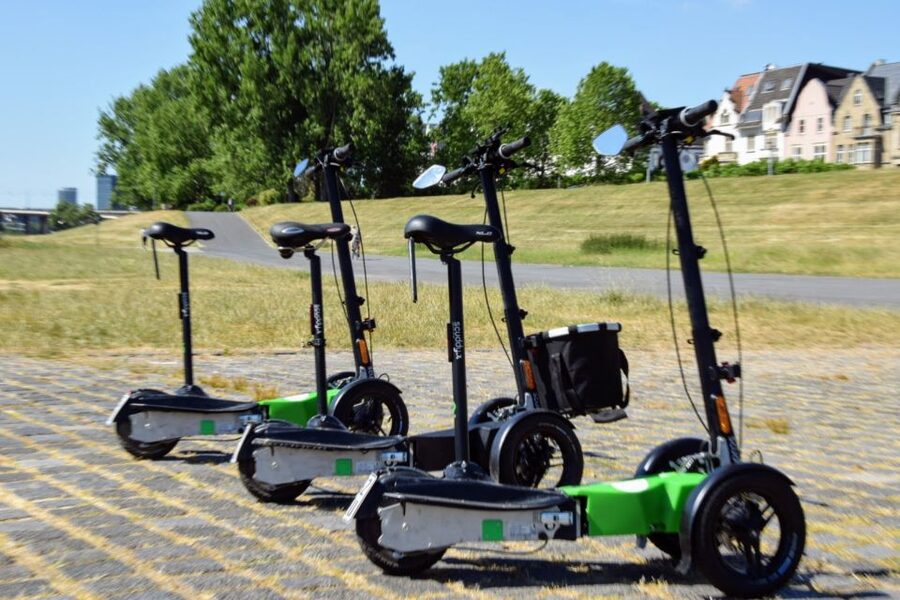
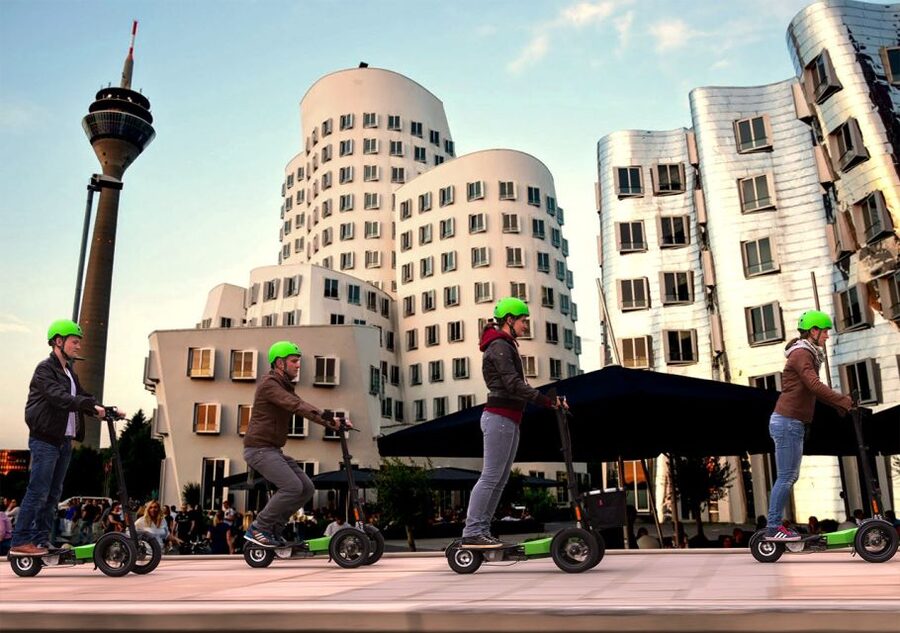
Before setting off, you get your Scuddy and helmet. The Scuddy can be ridden sitting down or standing up, so you can choose the position that feels more comfortable. You still need a driver’s license, and people without one cannot join.
The small group size matters here. With only 2 to 7 people, the guide can keep an eye on the riders and stop without managing a large crowd. If you are traveling as a couple, you might get a particularly personal outing. The tour can also feel more relaxed than a large bus or walking group, where the guide must keep moving and repeat every point for a crowd.
The vehicle is part of the appeal. This is not a quiet museum visit or a formal architectural walk. You are operating an easy-to-handle electric scooter while taking in the city, so the ride itself becomes part of the entertainment. The sitting option is helpful if you do not want to remain upright for the full two hours.
More Electric Scooter Tours in Germany:
- 2 Hours Hamburg E-scooter Tour
★ 4.2 · 103 reviews - Cologne: Guided E-Scooter Tour
★ 4.7 · 90 reviews - Berlin: Thrilling E-Scooter Adventure Tour
★ 4.5 · 71 reviews
Rhine views, the state parliament, and the Rheinknie Bridge
The first section follows the Rhine. You begin with views of the state parliament building and the Rheinknie Bridge, a broad and memorable piece of Düsseldorf’s riverfront.
This opening stretch gives you a quick sense of the city’s shape. Düsseldorf is not only an old town of narrow lanes and historic churches. The Rhine, government buildings, bridges, promenades, and newer architecture all play a large role in its identity.
The river route is also a sensible way to begin. You can get used to the Scuddy in a relatively open setting before moving into busier central areas. The guide sets the pace, and the route is designed as a sightseeing ride rather than a race.
Do not expect long, detailed commentary at every landmark. The tour is deliberately casual, with local humor and short explanations instead of a full art-historical lecture. That is a strength if you want an easy introduction, but a weakness if you are looking for exact dates, detailed architectural analysis, or a scholarly account of Düsseldorf.
Burgplatz and the old town riverfront
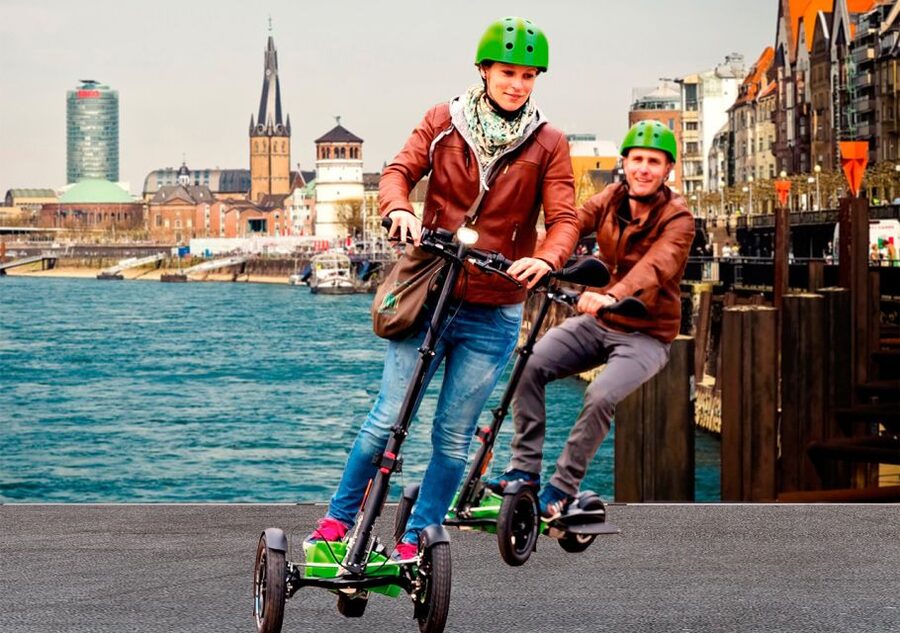
The route crosses Burgplatz, one of the city’s best-known public spaces. The castle tower gives the square a clear historic marker, while the Rhine keeps the setting open and spacious.
Burgplatz is a good place for the tour’s old-meets-new rhythm. You are still close to the river, but the city’s older center begins to close in around you. The route does not simply hurry past. Regular stops give you a chance to look around and hear explanations about the buildings, city, and local history.
The guide’s personality matters in this part of the ride. Dieter, named in several recent bookings, is described as relaxed and funny, with jokes mixed into the information. That style will suit you if you prefer a guide who talks like a local showing friends around. It may not suit you if you want a tightly scripted commentary with a fact at every turn.
The tour continues toward the Oberkassel Bridge and then to St. Lambertus Church. Keeping close to the Rhine helps connect the sights, and you get a clearer sense of how the river shapes Düsseldorf’s central districts.
St. Lambertus and the city’s older character
St. Lambertus Church is easy to recognize because of its leaning tower. The church gives the route one of its strongest historic views, especially after the wide riverfront and modern bridge.
This stop helps balance the contemporary parts of the tour. You see Düsseldorf as a city with old religious buildings, public squares, and long-established streets, not just as a shopping and business center. The church is also a useful visual anchor when you are trying to remember the route later.
The stop is not presented as a full church visit. The focus remains on the outside setting and the surrounding old town. If you want detailed information about the church’s interior, construction, or religious art, you will likely need a separate visit or guide.
That is a recurring theme here. You get many sights in a short time, but the price of that range is limited depth. One recent booking rated the city information as sparse and not always well verified. I would take that criticism seriously if your main reason for booking is history. For an informal introduction with a vehicle that is fun to drive, the lighter commentary is less of a problem.
More Scooter City Tours in Germany:
- 3-H E-scooter Sightseeing Tours in Berlin
★ 4.5 · 5 reviews - Berlin: 3-H VIP Private E-Scooter Highlights Tour
★ 4.5 · 4 reviews - Saigon: City Highlights and Saigon Unseen Scooter Combo Tour
★ 4.9 · 1,366 reviews - Rome: Highlights Vespa Sidecar Tour with Coffee and Gelato
★ 4.9 · 747 reviews
Andreas Quartier, where old town life feels current
From St. Lambertus, the tour moves into Andreas Quartier. This area brings together housing, art, culture, and food, giving you a more current view of central Düsseldorf.
It is a useful stop because it shows how the city has adapted older urban spaces for modern life. Instead of seeing the old town only as a historic backdrop, you see it as an active part of the city, with places to live, eat, and spend time.
The tour’s small size is especially useful in this kind of area. A group of seven can pause and listen without creating the same visual block as a large guided party. You still need to follow the guide and manage your Scuddy carefully, but the experience is more personal than a large organized outing.
This is also where the tour’s tone becomes clear. You are not being led through a list of dates. You are getting a local route with a bit of humor, a few stops, and a look at how Düsseldorf feels now. If that sounds like your kind of sightseeing, Andreas Quartier is likely to be one of the more enjoyable parts.
K20 and the Hofgarten route
The ride continues past K20, the art collection on Grabbeplatz, before heading through the Hofgarten. K20 adds Düsseldorf’s art reputation to the route, while the Hofgarten gives you a calmer green section after the dense streets of the center.
You should not expect entry into K20. The building and its place in the city’s art scene are part of the sightseeing route, but this is an outside viewing stop. If modern and contemporary art is a major reason for your visit, plan a separate museum visit rather than relying on the tour for an art experience.
The Hofgarten changes the pace. The route is not only about shopping streets, bridges, and architecture. Passing through the park gives you a break from the harder surfaces of the central city and shows another side of Düsseldorf’s planning.
The guide’s role remains important because the tour does not provide an audio system or written route details in the supplied information. You are depending on the live German commentary for context. If you do not understand German, you might still enjoy the ride and sights, but you will miss the main layer of the experience.
Kö-Bogen II and the green side of modern Düsseldorf
The route then heads to Kö-Bogen II, known for its very large green façade. It is one of the tour’s most distinctive modern sights and a sharp contrast to St. Lambertus Church and Burgplatz.
This is a good example of why the tour works as a city overview. In one outing, you move from a leaning church tower to a major contemporary building designed around planted exterior surfaces. You get a quick lesson in Düsseldorf’s visual range without spending the whole afternoon inside museums.
The building is best treated as an architectural viewing point. The tour does not include an interior visit, and you should not expect an extended explanation of its design. Still, the green façade is unusual enough to make this part memorable.
After a detour to the Schauspielhaus, the route reaches the Drei-Scheiben-Haus. This 1960s building has a strong, clean form and gives the tour another piece of modern architecture. Together, Kö-Bogen II, the Schauspielhaus, and Drei-Scheiben-Haus show how Düsseldorf’s central districts continue to change around older streets and public spaces.
Schadowstraße and the ride back to the Rhine
The final section moves slowly through Schadowstraße, now a pedestrian shopping area, before returning along the Rhine promenade to the Rhine Tower.
The slower pace is welcome near the end of a 2-hour ride. You have already covered several parts of the center, and the return route gives you time to connect the modern shopping area with the riverfront you saw at the beginning.
Schadowstraße adds a practical, everyday side of the city. This is not a postcard-only route. You see where people shop and move through the center, alongside the landmarks and grand buildings.
The return to the Rhine also gives the tour a tidy shape. You start with the city’s tallest building and riverfront, move through old town, art, parks, shopping, and modern architecture, then finish where you began. You do not need to arrange transport between several disconnected stops.
What $69 buys you in two hours
At $69 per person, this is not the cheapest way to see Düsseldorf. The value rests on three things: the vehicle, the live guide, and the amount of city covered in a short period.
You get a helmet, Scuddy, and guide included. You are not paying only for transport. The guide handles the route and adds explanations, while you get a city ride that would be difficult to reproduce on foot in two hours.
I think the price makes the most sense if you are short on time, enjoy unusual transport, or want an easy orientation before exploring on your own. It is also a reasonable choice for people who find a long walking tour tiring but still want to move through several central districts.
The value is weaker if you want a deep history lesson. The commentary is casual, and one booking specifically found the information limited and partly insufficiently checked. Since the tour is German only, the price is also hard to justify if you will understand little of what the guide says.
The rating is 4.5 out of 5 from 70 ratings, and 86 percent of participants gave it a perfect score. The strongest praise centers on the fun of riding the Scuddy, the relaxed guide style, the frequent explanations, and the personal feel of small groups. The less positive response focuses on the quality and amount of city information. That gives you a fairly clear picture of the tradeoff.
Who will enjoy this Düsseldorf tour?
I would recommend it most to:
- Visitors who want a quick first look at Düsseldorf
- People who enjoy trying unusual city transport
- Couples or small groups who prefer a personal tour
- German speakers who like casual local humor
- Travelers who want riverfront, old town, shopping, art, and modern architecture in one route
- Anyone who would rather ride than walk for two hours
I would be more cautious if you want a formal history tour, detailed art commentary, or an English-language experience. You should also skip it if you do not have a driver’s license, since that is a firm requirement.
The ride is described as easy to handle, but you are still responsible for operating a motorized vehicle in the city. Pay attention during the introduction, follow the guide, and choose the sitting or standing position that feels secure.
Should you book the Scuddy tour?
Book this tour if you want a fun, compact introduction to Düsseldorf and you speak German. The route covers a lot without feeling like a checklist, and the Scuddy gives the outing a playful twist. Guide Dieter’s relaxed style, jokes, and regular stops can make the city feel more personal than a standard sightseeing circuit.
Skip it if you need English, want a serious architectural or historical study, or prefer to spend time inside museums and churches. At $69, the tour earns its price through the vehicle, small group, and broad route, not through exhaustive commentary.
For the right person, it is a lively way to get your bearings fast, see both old and new Düsseldorf, and decide which places deserve a longer visit later.
FAQ
Where does the Düsseldorf E-Scooter City Tour start?
The meeting point is in the parking lot near the entrance barrier, in front of the Rheinturm, or Rhine Tower.
How long does the tour last?
The tour lasts 2 hours.
How much does the tour cost?
The listed price is $69 per person.
How many people are in each group?
Groups range from 2 to 7 people.
Is the tour offered in English?
No. The tour is offered only in German.
Do I need a driver’s license?
Yes. You must bring a driver’s license to take part.
Is a helmet included?
Yes. The tour includes an e-scooter and helmet, along with the guide.
Can I ride sitting down?
Yes. The Scuddy can be ridden in either a sitting or standing position.
Can I cancel for a full refund?
Yes. You can cancel up to 24 hours in advance for a full refund. You can also reserve now and pay later.
Just added around Germany
- 2 hour Sights Guided E-Scooter Tour in Munich★ 4.0 · 6 reviews
- 2 Hours Guided Hamburg E-Scooter Tour★ 3.5 · 10 reviews
- 3-H E-scooter Sightseeing Tours in Berlin★ 4.5 · 5 reviews
- Private Guide Up to Group 6 – ONE Rickshaw, (E)Bikes, E-Scooters★ 5.0 · 3 reviews
- 2 Hours E-Scooter Tour★ 5.0 · 2 reviews
- Private Up to 12 Guests-ONE RICKSHAW, E-Bikes, E-Scooters★ 5.0 · 2 reviews
- 3-H Munich: Top Sights E-Scooter Tour with Local Guide★ 3.8 · 5 reviews
- Berlin: 3-H VIP Private E-Scooter Highlights Tour★ 4.5 · 4 reviews
Germany Scooter Tours, compared.

3-Hour Guided Small Group Fat Tire E-Scooter Tour
Read our review →Browse the lists this tour appears in