

Review · ATHENS SCOOTER TOURS
Athens by Night Electric ATV Scooter Tour
Athens changes character after sunset. On this three-hour ride, you roll through Plaka and past the Acropolis, ancient theaters, democratic meeting grounds, Roman monuments, and marble Olympic landmarks while the city lights come on around you. It is a lively way to connect Athens’ 3,000 years of history without spending the whole evening inside a museum.
I like the small group size, limited to 10 people, and the electric ATV scooters, which give you a fresh way to cover a lot of ground without adding exhaust to the old city. I also like the range of stops, from the Odeon of Herodes Atticus to the Panathenaic Stadium, and the patient instruction offered by Stelios, especially if you need time to get comfortable with the four-wheel scooter.
The main consideration is that this is a riding tour, not an entry tour. You will see and hear about major sites, but entrance fees are not included, and the schedule does not promise time inside each archaeological monument. Some city streets and hills may also feel less relaxed if you are not used to riding a small vehicle in urban traffic.
Key points about the Athens night ride
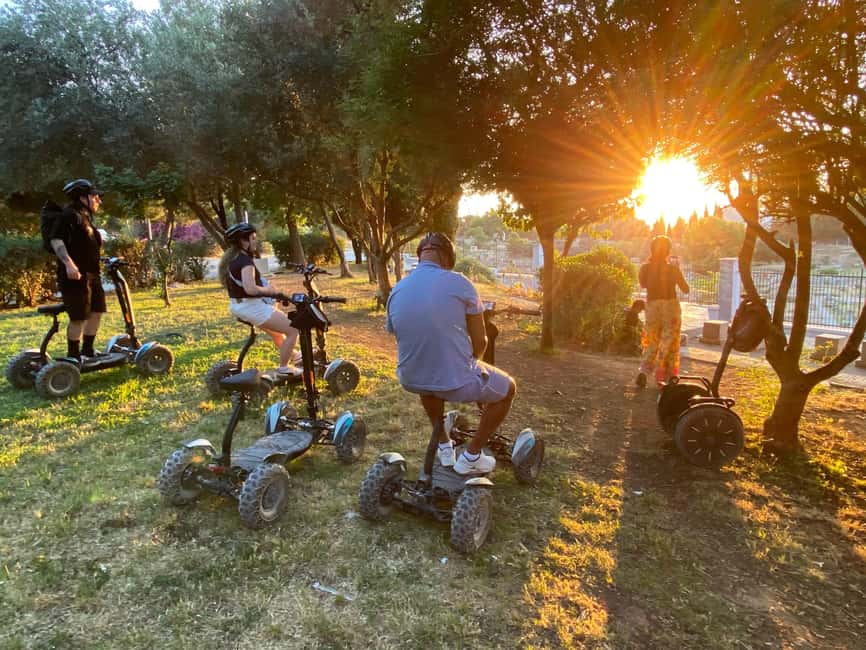
- Three hours through central Athens: The route links Plaka, the Acropolis area, Thissio, Monastiraki, Syntagma, and the Panathenaic Stadium.
- An electric four-wheel scooter: The small ATV offers a different experience from a walking tour and can be easier to manage than a two-wheel scooter for some riders.
- Ancient hills with major views: Areopagus and the Pnyx offer strong views toward the Acropolis and useful context about Athens’ ancient political life.
- A small English-speaking group: No more than 10 participants ride together with a live guide.
- A good first-night orientation: The route crosses enough of central Athens to help you understand how the main districts fit together.
- A sightseeing tour, not an attraction pass: Entry fees, meals, drinks, and hotel transfers are not included.
Why Athens works so well after dark
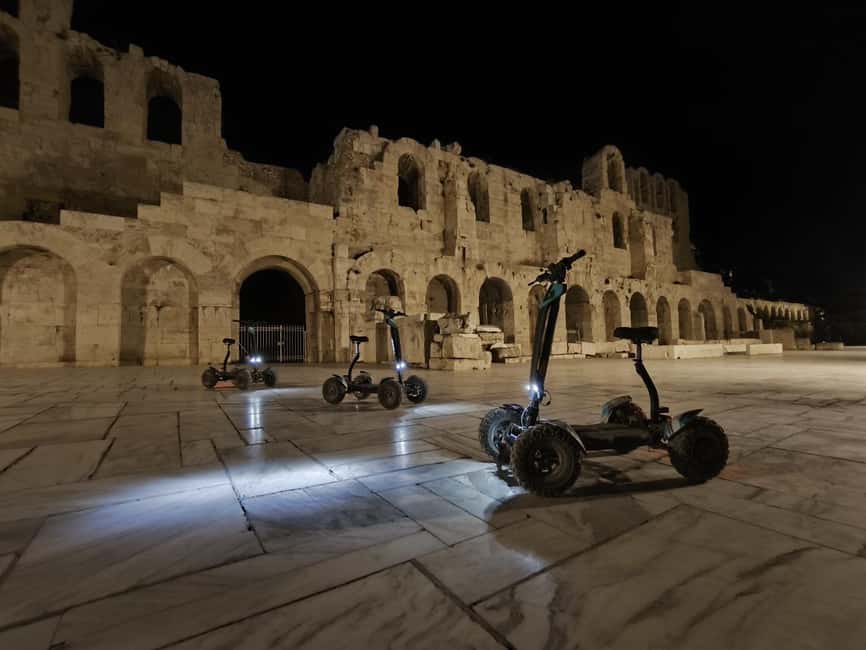
Athens is easier to understand when you see its old center as one connected place. The Acropolis is not an isolated monument. Around it sit the Ancient Agora, the Roman Agora, Plaka, Thissio, the Pnyx, Areopagus, and the old cemetery at Keramikos. This tour ties those places together by scooter.
Night also changes the mood. The stone of the Acropolis and the old theaters takes on a softer look under evening light. Streets that can feel hot and exposed during the day may be more pleasant once the sun drops, though the exact starting time varies, so you need to check availability for the date you want.
I especially like this format for your first or second night in Athens. After three hours, you will have a working mental map of the central districts. Later, you can return on foot to the places that caught your eye, such as the Ancient Agora, Roman Agora, or the narrow streets of Plaka.
The electric motor is another useful touch. You are not adding engine fumes to a densely visited historic center, and the quieter ride fits the evening setting. Still, do not mistake the scooter for a sightseeing vehicle that drives itself. You need to listen to the guide, follow the route, and feel comfortable controlling the ATV.
More Night Scooter Tours in Athens:
- Vespa Sidecar Tour By Night with Pickup
★ 5.0 · 1,803 reviews - Saigon Evening Food Tour by Scooter
★ 5.0 · 944 reviews - Bangkok: E-Scooter Night Tour with Local Street Food
★ 4.8 · 488 reviews
Starting in Plaka, Athens’ old-town gateway
The meeting point is in Plaka, the oldest and most picturesque part of the city. This is a sensible starting place because Plaka puts you right beneath the Acropolis and close to several major archaeological areas.
Your guide begins by getting you acquainted with the small ATV. The four-wheel design may feel unfamiliar at first, especially if you have only used bicycles or conventional scooters. One five-star booking specifically praised Stelios for being patient while the rider learned the vehicle, an encouraging detail for older participants or anyone who does not instantly feel at home on a scooter.
You receive a helmet, although wearing it is listed as optional, plus insurance. I would still treat the helmet as the sensible choice. Comfortable shoes are important, and a small bottle of water belongs in your bag. On warm evenings, bring sunscreen and light sunglasses. In cooler weather, an extra layer, gloves, or a scarf may be useful. If rain threatens, a plastic poncho can be provided.
Plaka itself is more than a pretty backdrop. It gives you an immediate sense of how modern Athens has grown around ancient foundations. The streets can be narrow, so the compact ATV matters. The tour is limited to 10 people, which should make it easier to stay together and hear the guide at stops.
The Acropolis and the Odeon of Herodes Atticus

The first major section takes you alongside the Acropolis. You get views of the UNESCO World Heritage site from below rather than an entry visit to the hilltop monuments.
That distinction matters. If your main goal is to walk through the Parthenon or see the Acropolis Museum, you need a separate plan and ticket. This ride gives you the outside view, the setting, and the chance to appreciate how the Acropolis dominates the center of Athens.
The route also reaches the Odeon of Herodes Atticus, the ancient stone theater on the southern slope of the Acropolis. Its curved seating and tall stone walls make it one of the most striking structures in this part of the city. The stop is a good reminder that ancient Athens was not only about temples and politics. Public performances were part of civic life, too.
Expect time for photographs and historical explanation rather than a long visit inside the theater. The tour’s value here comes from seeing the monument in relation to the Acropolis and the streets below.
Areopagus and Pnyx, two hills with different stories
The ride continues to the Hill of Mars, also called Areopagus. In ancient Athens, this rocky rise was linked with judicial proceedings. From here, the city opens out around the Acropolis, giving you a useful view of the terrain.
Areopagus is a particularly good photo stop, but it has a practical drawback: a hilltop viewpoint can involve uneven ground and a climb away from the scooter. You should wear shoes with a secure grip and take care when walking around the stop.
Next comes the Pnyx, one of the most meaningful places on the route. Ancient citizens gathered here to discuss and decide political matters, making it closely tied to the early practice of democracy. The important point is not just that the site is old. It helps you picture Athens as a city where civic decisions were made in an open setting by citizens gathered together.
The two hills work well as a pair. Areopagus represents judgment and law, while the Pnyx points to public debate and political decision-making. Your guide can place both within the physical shape of the city, something that is harder to grasp from a bus window.
More Quad Bike Rides in Athens:
- Ancient Athens Electric ATV Scooter Tour
★ 4.9 · 29 reviews - Best of Athens Electric ATV Scooter Tour
★ 4.3 · 5 reviews - Modern Athens Electric ATV Scooter Tour
★ 5.0 · 4 reviews - Scooter rentals ,Atv rentals and Buggy Rental,Nassau Bahamas
★ 5.0 · 40 reviews
Thissio and Keramikos, where everyday Athens meets archaeology

The route then passes through Thissio, a central neighborhood with close links to the Acropolis area. From there, you approach Keramikos Archaeological Site.
Keramikos was both an ancient cemetery and a center of pottery production. That combination gives the stop a more ordinary human scale than the grand monuments. You are looking at a place connected to burial, work, and daily life, not just rulers or temples.
Again, the tour does not include entrance fees, so treat this as a chance to see the location and receive context from outside unless you arrange a separate admission. If Keramikos is high on your list, return during its opening hours and give it more time than a riding itinerary can allow.
This section also shows why the ATV format can be useful. You move between districts that are close on a map but separated by busy streets and changing city scenery. On foot, you could make the same journey, but it would take more energy and planning. By scooter, the route keeps its pace and leaves room for several photo stops.
The Ancient Agora and Monastiraki at night
The Ancient Agora was the center of public life in classical Athens. It is one of the key places to understand how the city functioned, since politics, commerce, social life, and public discussion met here.
A night ride gives you the outside perspective and the story behind the ruins. If you want to walk the paths among the remains, visit during opening hours on another day. Entrance is not part of the $100 price.
From the Agora, the route moves toward Monastiraki Square. This is where ancient Athens meets present-day city life. The area mixes historic buildings, shops, restaurants, and evening activity, giving you a sharp change in mood after the quiet archaeological hills.
Monastiraki can be busy, so the group format matters. Stay close to the guide and follow instructions when moving through the area. You are not simply cruising without a plan. The value comes from seeing how the old center works as a living city, even after the ancient landmarks close for the day.
Nearby, you pass the Library of Hadrian and the Roman Agora. These sites show how Athens continued to grow under Roman rule. The Library of Hadrian was a major Roman-era complex, while the Roman Agora reflects another period of civic and commercial life. Seeing them near Monastiraki helps you read the city in layers instead of treating ancient Greece as one single era.
Syntagma Square and the modern Greek state
The ride returns through Plaka and continues to Syntagma Square, the political heart of modern Greece. Here you see the Hellenic Parliament and, when the timing works, the changing of the guards.
The ceremony connects present-day Greece with older traditions of public authority, but it also adds a modern civic stop to a route otherwise filled with ancient sites. Timing is important. The information promises a chance to witness the changing of the guards, but exact ceremony times are not provided, so check with the operator if this is a top priority.
Syntagma also helps balance the tour. You are not spending three hours looking only at ruins. You see the square where modern national life takes place, then continue toward the National Gardens and Zappeio Mansion.
The National Gardens offer a quieter stretch in the center, while Zappeio Mansion brings a more formal 19th-century setting to the route. These stops help show that Athens is not frozen in antiquity. The city has layers from ancient, Roman, Ottoman, modern, and contemporary periods, though the tour focuses most strongly on the ancient and classical story.
The Panathenaic Stadium and Roman Athens
The Panathenaic Stadium is one of the most memorable final stops. Built entirely of marble, it hosted the first modern Olympic Games in 1896. Its bright stone seating gives it a look unlike the ancient ruins earlier in the tour.
You may find this stop especially useful if you know Athens mainly through its classical monuments. The stadium links ancient athletic traditions with the modern Olympic movement. It also gives the route a strong visual finish, since the marble structure is easy to recognize and photograph.
The final historical stops are Hadrian’s Arch and the Temple of Olympian Zeus. Hadrian’s Arch marked a division between the old Greek city and the Roman expansion associated with Emperor Hadrian. The Temple of Olympian Zeus, with its huge surviving columns, conveys the scale of Roman-era building in Athens.
These sites are close enough to fit naturally into the route, but do not expect a full archaeological visit. You will see the landmarks and hear their place in the city’s story. For detailed examination, plan a separate daytime visit and confirm entrance arrangements.
What the $100 price gives you
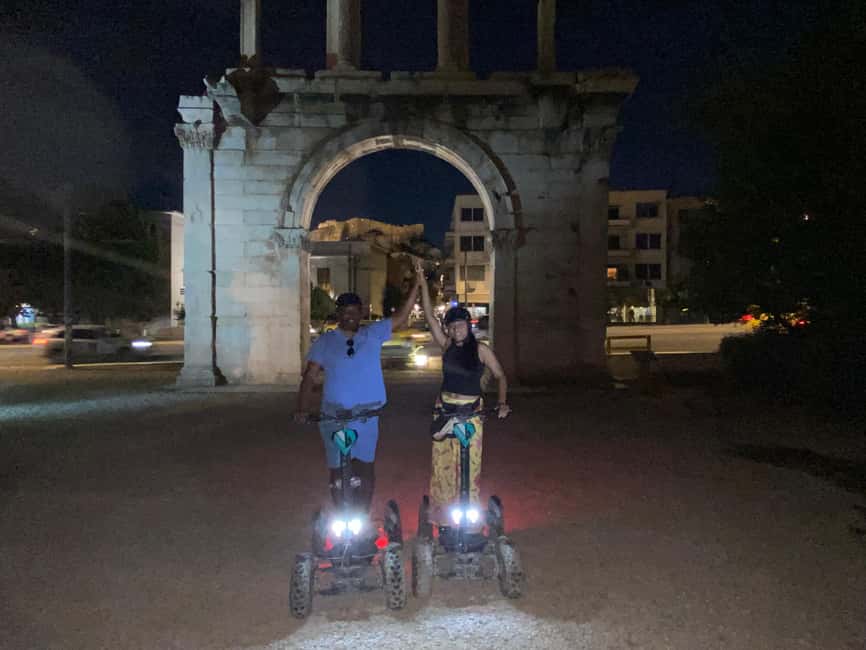
At $100 per person, this is not the cheapest way to see central Athens. You are paying for the electric ATV, a guide, insurance, a small group, and a carefully connected route over three hours. The value depends on how much you want transportation and explanation combined.
I see the strongest value in the coverage. You reach Plaka, the Acropolis area, Areopagus, Pnyx, Thissio, Keramikos, the Ancient Agora, Monastiraki, Syntagma, the Panathenaic Stadium, Hadrian’s Arch, and the Temple of Olympian Zeus in one evening. Covering that much territory on foot would require more time and stamina.
The price is less compelling if you mainly want entry inside the archaeological sites. Food, drinks, hotel pickup, hotel drop-off, and admission fees are extra. You should also compare the cost with a normal walking tour if you enjoy moving slowly and do not need a vehicle.
For someone who wants an efficient first look at Athens, the price can make sense. The single five-star account available describes the tour as informative, fun, and particularly suitable for older riders. That is useful because the ATV may reduce the walking burden, though it does not remove the need to balance, steer, and walk during stops.
Who should book this Athens experience?
I would choose this tour if you want to cover a lot of central Athens in one evening, prefer a small group, and like the idea of moving between sites instead of following a guide on foot. It suits first-time visitors who want to understand the city’s layout early in a trip.
It may also work well for older participants who find a long walking tour tiring. Stelios’ patient help with the vehicle is a real advantage if you need extra instruction. Still, the tour is not suitable for children under 9, and you should be honest with yourself about your comfort operating a small ATV.
You should think twice if you dislike riding in city streets, want long quiet visits at each monument, or plan to go inside every major archaeological site. This is a moving overview with focused stops, not a full archaeological study.
The English-speaking guide is another clear point. If English is not comfortable for you, the activity may lose much of its value because the historical explanations are a major part of what you are paying for.
Practical details before you reserve
The tour lasts three hours, but starting times vary. Check the available evening departure when booking. Cancellation is free up to 24 hours in advance, and you can reserve now while paying later, which helps if your Athens schedule is still shifting.
Wear comfortable shoes and bring water. Use sunscreen on exposed skin during hot weather, and add a warm layer in cooler seasons. Gloves and a scarf may help when the evening air turns cool. A poncho can be provided if rain is expected.
Helmets are listed as optional, but I recommend using one. Insurance is included, as is the tour leader. No hotel pickup or drop-off is provided, so plan your own way to Plaka and back.
Should you book the Athens by Night Electric ATV Tour?
Book it if you want an efficient, unusual introduction to central Athens, especially early in your stay. The combination of electric transport, a small group, major viewpoints, and Stelios’ patient instruction gives you more than a simple ride. You get a useful map of the city and a clear story linking democracy, Roman power, modern Greece, and the Olympics.
Skip it if your priority is going inside monuments or spending long periods at one site. At $100, the experience earns its price through coverage, guidance, and convenience, not included admissions or meals. For a confident rider who wants Athens after dark and appreciates a well-connected route, it is a strong choice.
FAQ
How long is the Athens by Night Electric ATV Scooter Tour?
The tour lasts three hours.
Where does the tour begin?
The tour begins in the Plaka neighborhood in central Athens.
What language is the tour conducted in?
The live tour guide speaks English.
How large is the group?
The tour is limited to 10 participants.
Is the tour suitable for children?
Children under 9 are not permitted to join.
Are entrance fees included?
No. Entrance fees for archaeological sites and other attractions are not included.
What should I bring?
Bring comfortable shoes and a small bottle of water. In hot weather, bring sunscreen and lightweight sunglasses. During cooler seasons, bring an extra layer, and consider gloves and a scarf.
Just added around Athens
- GoPro Adventure Tour in Acropolis area by E-Scooter★ 4.5 · 8 reviews
- 10 Days Tour Walk Athens Cycle Peloponnese Scooter Santorini★ 5.0 · 4 reviews
- Modern Athens Electric ATV Scooter Tour★ 5.0 · 4 reviews
- Best of Athens Electric ATV Scooter Tour★ 4.3 · 5 reviews
- Athens: Guided City Tour on an Electric Trikke Scooter★ 4.4 · 7 reviews
- GoPro Adventure Tour in Acropolis area by E-Scooter★ 4.9 · 19 reviews
- Ancient Athens Electric ATV Scooter Tour★ 4.9 · 29 reviews
- Athens: Premium Guided E-Scooter Tour in Acropolis Area★ 5.0 · 133 reviews
Athens Scooter Tours, compared.
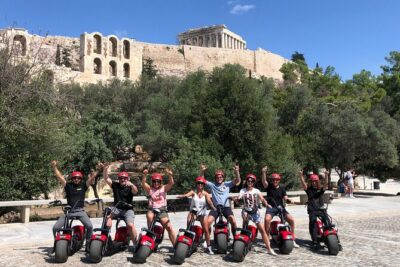
Athens Acropolis Official E-Scooter Guided Tour Fat E-Bike
Read our review →
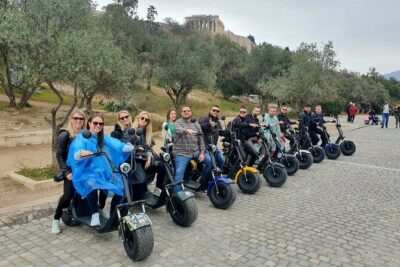
Premium Guided E-Scooter Tour in Acropolis Area
Read our review →Premium Guided E-Scooter Tour in Acropolis Area
Read our review →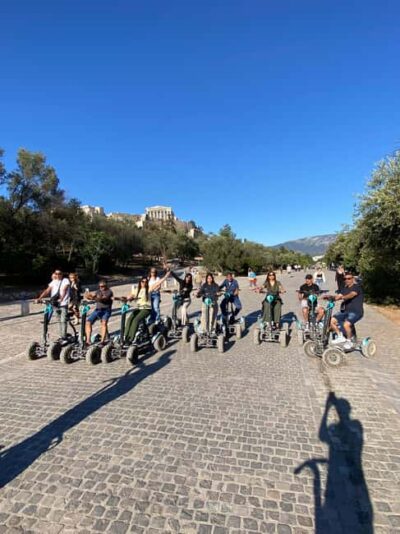
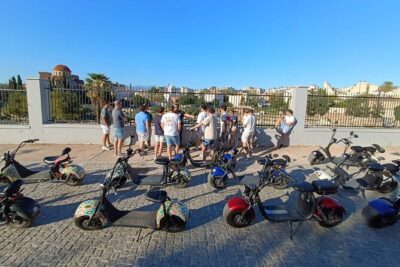
GoPro Adventure Tour in Acropolis area by E-Scooter
Read our review →GoPro Adventure Tour in Acropolis area by E-Scooter
Read our review →Browse the lists this tour appears in